Sunday, July 31, 2016

A sensory pod from an improvised black-out tent

Ever since we went to Myseum,  I've wanted to make a sensory space like theirs, featuring glowing lights in a dark area for Mason. He really enjoyed that exhibit, since he has light perception, and thought it was very cool...
They have blacklight-reactive letters and shapes on a carpeted wall, which we may eventually try to do.  But in the meantime, I was thrilled to find a way to give him a blackout sensory space that's more affordable. I was actually looking for a way to mimic the feeling of being in one of those small inflatable kids ball pits because Mason used to love his Mickey Mouse Clubhouse ball pit.  But it popped very  fast so we needed to think of an alternative.

One solution is using a black pop-up portable pod like this one one from Amazon. Blackout tents marketed for people with special needs cost hundreds of dollars, but this one is marketed as a dressing room and cost me $39.99. (It needs a wall nearby for stability, since it's made for staking into the ground...wouldn't work for horseplay inside.) With pillows around the sides, a long cushion from an outdoor lounge chair to sit/lean on, and a body pillow across the doorway, the feeling is very similar to the inflatable ball pits. Soft is important so Mason feels safe. I think he approves :)


And the black walls make for an extra layer of fun with toys that light up!


We're excited to find more ways to play with light in his own sensory pod  :)

Thursday, February 25, 2016

Communication Update...My First AAC w/ Tactile Keyguard

Mason recently received a grant from Ellie's Project for an iPad Air to help him communicate! It has been amazing for him! We are using an app called MyFirstAAC. Because he can't see well to find the buttons for words, we made a homemade "keyguard" (soft grid around buttons made of the fuzzy side of Velcro). This new setup allows Mason to show us what he is capable of in hopes that he may eventually be able to get a device with bigger screen like Tobii T15 (possibly with eye gaze system) or similar through insurance. He has to be able to prove he can use AAC to get it covered, as the Tobiis are uber expensive. Although these videos may seem to show very simple accomplishments (touching a button to say a word or phrase), they show he has the desire and intent to communicate, the motor ability to do so, the cognitive ability to accurately know what to say, good enough hearing ability to understand what the button says when he presses it, and the tactile discrimination/memory to locate a specific button mostly by touch. We are beyond thrilled with this progress and wanted you to see what he is learning too! :)

In this video, Mason and I have been playing with a ball on his tray. The ball fell to the floor, and he asks for it back! :)


In this video, Mason's favorite cartoon is ending and he wants me to restart it. Watch as he thinks about what to say, and then presses, "Come here please!" very deliberately :)


People were overwhelmed with amazement. “He has done everything well,” they said. “He even makes the deaf hear and the mute speak.” Mark 7:37


Sunday, February 07, 2016

Closer to answers?

It's been a long time since our family visited NIH for the Undiagnosed Disease Program (2012) - 4 years! We recently received results both from the NIH and from a re-testing done by our home genetics drs (this clinical whole exome test wasn't available at the time we signed up for NIH).

I will warn you the results of this testing were hard to swallow because I am a carrier of some very bad things. But apparently everyone carries at least 7 or 8 diseases, some deadly...you would just never know which ones unless you had such extensive whole exome testing or had an obvious family history (I come up negative for every disease mutation tested on extensive PANORAMA preconception genetic panels, FYI, so there's no way I could have known any of it existed in advance).

MASON

  • STRA6. Mutations in this gene are known to cause a severe syndrome involving anopthalmia (meaning affected babies do not develop eyes). Because it is a recessive disease and Mason only has one mutated STRA6, not two, they aren't sure how much it's affecting him. Because he has such severe eye defects, plus many other mutations in concerning genes (see below), plus the deletion we already knew about, these other changes may be making STRA6 affect him more severely than it would affect other carriers...aka, me :/ Mason inherited this mutation from me, on chromosome 15.
  • GLE1. Mutations in this gene are known to cause a severe disease in babies called Lethal Congenital Contracture Syndrome. But since it is a recessive disease and Mason only has one mutated GLE1, not two, they aren't sure how much it's affecting him. Mason didn't inherit the GLE1 mutation; it was de novo (a new mutation not affecting anyone else in the family).
  • MON2. No one knows anything about this gene, but Mason has two mutated copies of MON2 (one from me, one from Brian). It has never been associated with human disease and there's not much mice research to go on, so they aren't sure what effect it's having on Mason, if any. The fact that he has 2 mutated copies makes it something to consider. (Micah inherited neither of these mutations).
  • COL4A6. Mutations on this gene are known to cause familial deafness. They said it may play a role in Mason's hearing impairment. It is X-linked, inherited from me (sigh). Micah didn't get this mutation, just Mason. In X-linked conditions, males are affected more severely than females (because girls have 2 X chromsomes, the healthy X can sometimes compensate for any mutations on the other one; guys only have 1 X and 1 Y so cannot compensate as easily).
  • WDR37. This mutation is the one everyone is focusing the most attention on right now. Mason only has one WDR37 mutation, not two, but in mice, mutations in this gene have caused problems similar to Mason's. Not only that, but since the NIH results were reported, the clinical lab reports two other children have been located with single mutations on one copy of this gene and they have similar categories of features. Our doctors are in process of contacting them; if they can confirm the kids are very much alike, it is possible Mason is one of three with a new syndrome. If they aren't as alike as they sound in the report, it's more likely that "Mason syndrome" is simply due to a totally unique combination of all these mutations plus the deletion. No one else in the family is affected by this mutation. It is de novo (new/not inherited).
MICAH

As if it wasn't crazy enough that Mason has all these "never before seen" mutations and the three of us share a "never before seen" deletion, it gets crazier.

Micah also has his own "never before seen," probably disease-causing, mutation, which Mason doesn't have.  We hope to be able to share more info on this mutation soon.

 All this to say... more waiting but we may be closer than ever before to knowing whatever is knowable from a genetics standpoint, and maybe once we know more details, there eventually may be ways to help alleviate some of their symptoms. Overall, it confirms what we already knew...life is good and God is great and our futures are in His hands no matter what the results say :)

Saturday, March 28, 2015

Mason's ramp by Gramps :)

This past week we were incredibly blessed by both sets of Mason's grandparents! "Papa" (Brian's dad) met Brian with his car full of his tools and big saws to be used on a very special project. Then Mason's "Gramps" (my dad) used Papa's tools to build a very snazzy wheelchair accessible ramp in our garage, complete with a spring-hinge gate and step for the rest of us:)

It turned out great and has already been used several times - we love that Mason can be loaded into the van so easily without exposing him to weather and with much less heavy lifting required!! I can also take Mason out for a walk easy as that, anytime (if the weather will just warm up soon!!) He will LOVE that (and so will I)!!

We are so grateful to God for such awesome grandpas :)
Our hearts thank you so much, and so do our backs!!! :D

"Every good and perfect gift is from above." 
James 1:17

Thursday, March 19, 2015

Hip surgery decision update

Many of you have been praying with us about Mason's hips and what to do about the surgery decision. Thank you for those prayers, and please keep them coming :) Here is an update about what is going on so far.

We actually had hip surgery scheduled for late February with a dr who said he does the surgery without using the full spica cast (just immobilizers instead).

However, in January, when Mason had his 4th set of ear tubes placed, and a dental cleaning under sedation, he had a major reaction to the intubation which caused him to have difficulty breathing (post-ventilation stridor - edema/inflammation/swelling of his airway) for 2-3 days afterward. This was very scary and because his eyelids were also swollen and he had skin blotches we don't know if it was an allergic reaction or mechanical reaction to the vent alone; it happened despite all kinds of preventive measures (steroids, anti-inflammatories, etc). And that surgery was about as minor as it gets...less than an hour under sedation w/ very minimal pain. The proposed hip surgery was going to take many hours, and the post op pain predicted to be off the charts even with strong meds (the dr would be sawing both legs in two and nailing them back together in many places).

Then, the day we were originally supposed to meet with surgeon for the pre-op hip consult, Mason was having his first day of recovery from one of the worst stomach bugs he's ever had. He was so sick from a Monday to Sunday that we literally feared for his life on several occasions - due to difficulty keeping him hydrated (and IVs when he is dehydrated are so impossible and stressful that we feared in his extremely weak state he would have a bad outcome from the trauma). God's grace in every way brought him through this!! We have lost a few years of our lives (like the machine that sucks it away in Princess Bride lol!) but although he lost a few pounds he's back up so well now that we actually were told by the dietician to back off 50 mls of his formula (even though he's already calorie restricted!?). Still, we could not in good conscience allow him to go through such a huge surgery especially after all he'd already been through in Jan. and Feb. The benefits to risks just do not seem worth it.

Besides all that, we found out that only about 50% of those w/ neurological conditions and hip displacement have pain from it (the other half don't have any pain from it). And we found out that the younger the child is when he is operated on, IF he also cannot walk, the higher the chance he'll need the surgery again: "Those with the greatest burden of disease require earlier surgery and suffer from the higher revision rates (need for repeat surgery)."   Besides that, it wasn't really going to help him in any functional way, as surgery in kids who can't walk has been shown "unlikely to maintain or restore mobility. Furthermore, it carries a significant risk (63.6%) of complications." 

Several moms of kids who did this surgery said their child was not in pain before the surgery but was afterward, and they regretted it,  or some skipped it without regret. Mason's rehab dr, after discussing this with her, said that if he is not in pain now, we can watch and wait; surgeries after hips dislocate have a low chance of success but there are new management strategies on the horizon to help with pain if hip surgery is never an option for him (ie, Botox, nerve blocks, etc).

So, we are going to wait and pray. Pray that Mason's hip socket continues to develop and that he does not ever need the surgery due to pain or full dislocation. We are incorporating everything we know how to do to slow the dislocation process down. For example:

1. 24/7 POSTURAL CARE!! Nobody has ever told us that sleep position can cause hips to dislocate faster (along with other horrible effects like constipation, scoliosis, body asymmetry, digestion issues and more) but we have been researching like mad and discovered ways to help stop and prevent further issues through positioning. Mason has been a side sleeper since birth, and simply supporting him at night with pillows in proper alignment can supposedly help arrest hip dislocation. So, we have been using a knee pillow and having him hug a cylindrical toy until we are able to transition him to sleeping on his back with supported hips (the preferred position, but we don't know if he can breathe well enough with reflux issues in this position). During the day, proper support in his wheelchair or other seating systems will help protect his body shape. The need for postural care especially at night is only recently being warned about in USA but it is well documented in Europe.

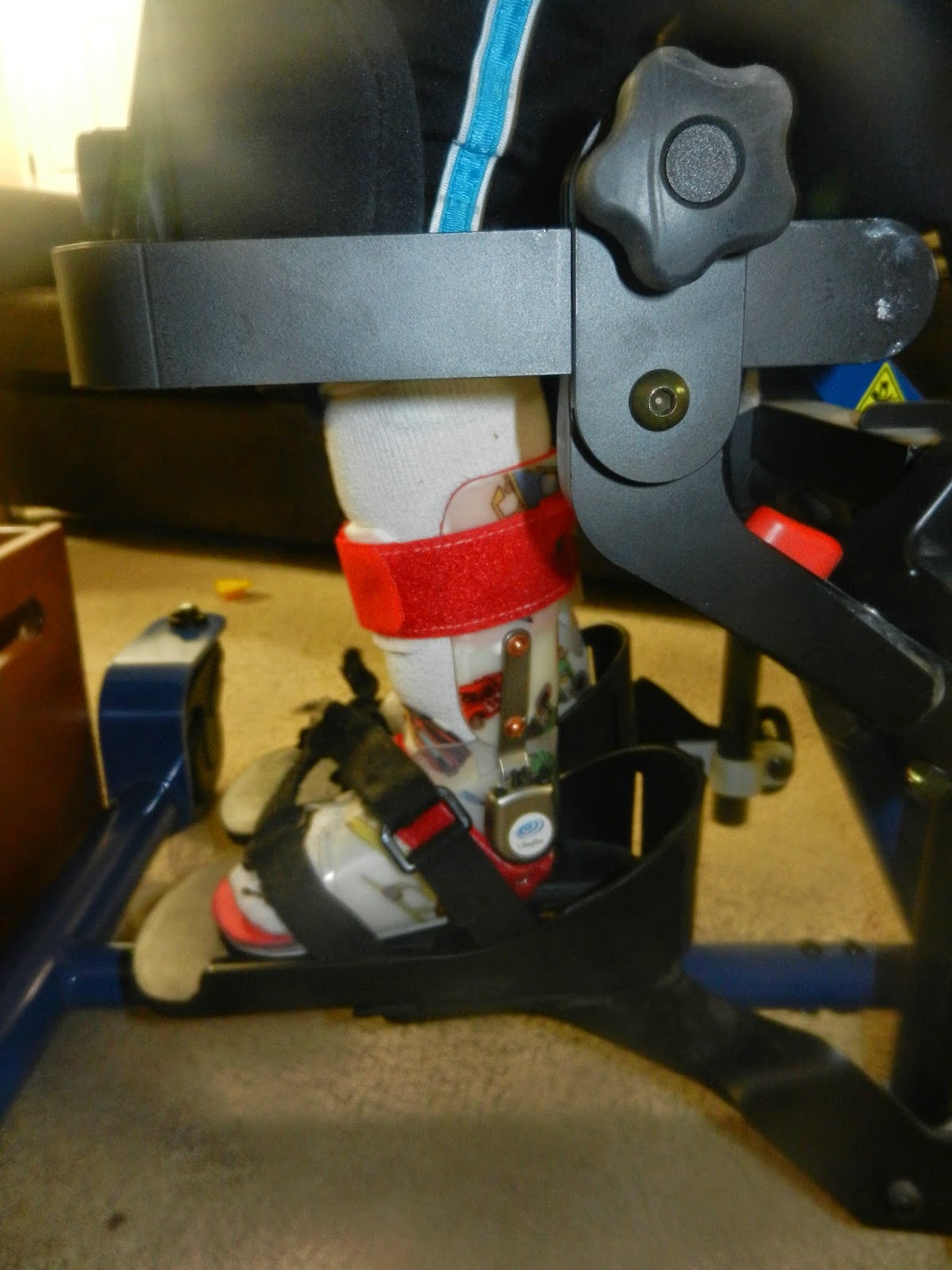
2. Standing as long as tolerated each day in a stander (For Mason that's 30 min to an hr - usually about 45 min). He has new DAFOs (hinged kind) that have a special joint with a style made just for him that the orthotics lab has never made before, bends at the ankle and has plantar stop to help his tone in his feet (he tends to point toes like a ballerina). He feels very strong in these, is hyperextending knees less and is standing with less support! The more he will stand, the better his hips have a chance to continue to develop good sockets.

3. Using an ergonomic backpack (A Tula toddler carrier) to help his legs stay in good "frog" position to form sockets); we also carry him in this position when not in the backpack for transitions room to room if not in his wheelchair.

4. Firefly Upsee. We were given one of these incredible systems through a grant, and after reading this miraculous hip story about Daniel we are determined to use it as often as possible (even though it dislocates MY hips to use it with him lol--he is a heavy guy!) When he outgrows this we are very interested in a new product (not yet available in USA) called InnoWalk (like a stander mixed with an elliptical trainer) that would allow Mason to "walk" supported (and continue to develop hip sockets) even if he cannot ever walk on his own.

5. KidWalk gait trainer. Mason has been using this a couple years now and just recently learned how to make it go forward as well as backwards :)

Who knows if any of this will make a difference or if he will end up getting surgery eventually? But we want to do everything we can to try to keep him comfortable, and pray that God will bless us again with His grace to keep Mason's hips painless and developing well. We feel that God made it clear that at least for now this is not the time to proceed with surgery.

Tuesday, March 10, 2015

Exploring AAC

 
 Last year Mason had an evaluation with an AAC team (Augmentative and Alternative Communication) at our local children's hospital. They recommended we try auditory scanning with Mason, since we have always felt that he seems to hear better than he sees.

Auditory scanning involves listening to choices on an AAC device (iPad, in Mason's case) and waiting until the preferred choice is spoken aloud to hit a switch and choose that item. We've been working with the speech therapist provided by our local school district to try out some of this equipment with him (borrowing equipment from the state assistive tech library).

Before we tried scanning we wanted to be sure Mason understands cause and effect - that he knows hitting a switch helps him control a choice or action. We know he does because he uses his switch to activate a series of rewarding video clips in a simple, free app called "Sensory Room."

He also shows us while watching TV that he knows when to activate the switch (notice how, in the clip below, he is watching his favorite YouTube playlist on TV; when he knows a video is coming on he doesn't like (and he knows them by heart; he particularly doesn't like the song "Do You See an O" so in advance he usually fusses very aggressively to let me know he wants me to skip that one; but now that he has some AAC tools, he isn't fussing; he instead asks me very intentionally for help to skip it by clicking the head switch on his right :)


So, now that we know he understands use of the switch, one of the most basic apps we're using to teach auditory scanning is called Racing Cars  by InclusiveTLC. Mason loves it, and he understands that he needs to hit the switch to activate it; the next step is trickier as the voice will then say "nothing here" and keep saying "nothing here" until it gets to the box showing a car; then it says "a racing car;" Mason, upon hearing "a racing car" must hit his switch to choose it and make it race around the track.

The problem we are having is knowing whether Mason hears well enough to distinguish "nothing here" from "a racing car" when they are spoken in sequence. This is key for him to properly use the technology; we know he hears sound because he giggles but he giggles when either phrase is spoken. We are looking into the possibility that an FM system may help him hear more clearly to distinguish these phrases in a meaningful way. (Many people who do not hear well, even though sound may be amplified by hearing aids, explain that that hearing sound does not necessarily mean understanding the sound, especially on a TV, radio or other device). Mason knows he has to hit his switch again to make the car race, but he has trouble knowing when he should hit it this second time. Pray with us that audiology will be able to help us if know if distinguishing sound is an issue for him, and if so, some possible ways to overcome this.

For now, we are using the app GoTalkNow to make him some basic communication boards. But he'll need to show he can do auditory scanning before they are very functional for him. In the meantime, we're going to have him practice using screen mirroring on our TV (using a digital AV HDMI cord by Apple - where he can play his apps on the iPad but they display on the TV instead, and his switch still works with it). That way the display is much bigger so he can also hopefully see the images better. We are excited that so many options exist for helping kids with dual sensory losses make the most of their existing abilities to communicate with the world around them :) We'll update later with how it's going on the AAC front ...

Monday, November 10, 2014

Hip Dysplasia Second Opinion, and a Tough Decision

In August we found out that Mason's hips are partially dislocated and need a very big surgery called bilateral varus femoral osteotomy to fix them. Because there are so many factors to consider with Mason and surgery, we got a second opinion last week.

Here is a pic of NORMAL HIPS taken from the web (links to source)...
xray of normal hip anatomy of a child

See how nicely those femoral heads (the round parts of the tops of the leg bones) go into the sockets on each side by the arrows? They are almost flush with the joint socket inside, and the heads are well-contained inside the hip joint ... no part of the femoral head is uncovered past the green line shown. And the angle is pretty sharp as the legs face into the hip joint (see M to E above).

So at the second opinion dr, he took xrays of Mason AND Micah (because Micah has trouble running and sometimes walks with a stiff leg on one side and we know he has EDS but he's never had any x-rays of anything leg-related until now).

Here is MICAH'S XRAY
EDS hip dysplasia

The orthopedic surgeon said that Micah's hips are not in the sockets correctly either :/ In the pic you can see how on both sides the femoral heads protrude out of the socket by 25% or more. The heads also do not sit very flush against the inside of the sockets, and the angle at which his legs enter the hip is much straighter in his legs than what is normal. His femurs are also twisted a bit too much. He said because of underlying EDS (loose, stretchy ligaments), Micah's legs will more easily slide in and out of their hip joints and it may cause some issues in the future. This is something we will discuss more at his appointment with his EDS dr next month.

 Here is MASON'S XRAY:
hip dysplasia in hypotonia from neuromuscular disease
Mason's hip on one side is over 50% displaced. The other he called 40%. His doctor said he has "hips at risk" (of total dislocation) and that the dislocation is "inevitable" and that if we wait until skeletal maturity to operate and they come closer to being out, it "will be a disaster." Both drs agreed he should get the repair before he is 5 for best possible outcome. The reason for Mason's problem being worse than Micah's is that Mason has neuromuscular disease on top of lax ligaments/EDS. Many children with cerebral palsy have hip displacement surgery; although Mason doesn't have CP, he has hypotonia, and the lack of walking and normal weight bearing has prevented his sockets from developing normally (totally different than "DDH," or developmental dysplasia of the hips, which can happen to otherwise healthy children from environmental effects). While Micah's hips may slip in and out, Mason's will slip out and never go back without much more complex surgical intervention.

I have tried to look at this problem from all angles and really, really want our policy to be "no surgery unless the recovery is super easy or unless it is a life-threatening problem." However I am not sure we can in this case. Hip dysplasia is not a life-threatening condition in and of itself; however it is apparently a very big QUALITY-of-life threatening issue. We do not want to skip surgery if it will lead to unmanageable pain and a worse surgery later that will be less likely to help relieve his pain. This article sums it up: "Early diagnosis of hip displacement is important because treatment is more successful when children are young. When hips become dislocated and painful, it is very difficult to treat and there are not many options for treatment.  If the hip dislocates, the problems that the children will have are terrible and the pain can be difficult to treat. We recognise that some parents don't want to consider surgery, especially if it's before their child is in pain. Many parents agree to surgery as a 'last resort', and many choose to try complementary and alternative medicine options first to see if they will help the hips. However, we found in this study that if children miss the opportunity to have the surgery, it resulted in far worse outcomes for the children and more pain long term."

I asked his NIH team their opinion (whether benefit outweighs risk) and the deciding factor for them was to find out if the dislocation is symmetric. Since it isn't, it becomes more pressing to fix it; otherwise he will develop severe pain at his spine where the bones rub in sitting off balance.

We will need to just be covered in prayer for this surgery if he absolutely needs to have it, which it sounds like everyone we have consulted is in agreement that he does... here are some of the specific requests we have:

1. Doctor/hospital selection. The first doctor we saw has more experience and overall great reputation but he is at a different hospital than we have ever used for surgery and therefore they don't "know" Mason as well. It would be harder to collaborate with his other doctors there.The first dr also proposes a slightly more involved surgery, with possible need for a spica cast for 3-6 weeks to months depending on recovery. A spica cast is really out of the question for Mason because of his blowout diapers happening almost daily (and a cast change under sedation is required whenever it is soiled); there is no way we could have a cast change every day or two for weeks or months).

2. Pain relief. Narcotics cause major problems for Mason (GI--slowed motility/constipation/worse reflux and neurological issues (withdrawal, seizures, urinary retention which can cause cardiac problems) so we want to limit them but yet make sure he has plenty of pain relief. The doctor mentioned the possibility of a caudal block but he wasn't sure Mason is a candidate with his other issues. We don't want him to be on a ventilator long at all as he produces so much mucous from it that he needs to be suctioned extremely often, which causes bleeding inside due to fragile mucosal tissue, which is frankly miserable.

3. Complication avoidance. Our biggest concerns are life-threatening complications arising from surgery for a non-life threatening condition. We are concerned about blood supply (Mason has "pathologically small veins" and a previous unrelated procedure failed due to lack of blood supply; because this surgery causes major blood loss and frequent need for transfusions, we are concerned about avascular necrosis, blood clots/stroke (his labs show that he tends toward issues with thick blood, and his blood clots during collection, etc,), anemia, etc. The immobility is not a good combo. He also has immune deficiency which makes bone or wound infection a very real possibility.

4. Sleep. Mason is a side sleeper but this surgery will require him to sleep on his back for at least 1 month. He can't sleep on either side due to the wounds on both legs. He needs good sleep to avoid seizures and right now won't lay on his back at all due to fear of medical procedures in that position, etc. Please pray he adjusts quickly and easily.

5. Rehab...It sounds like it could be 8-12 months after surgery for Mason to be just "back to baseline" and that's if everything goes very smoothly. Pray it doesn't take that long to get back to sitting, rolling and using stander/gait trainer comfortably, and that he can exceed that once the hips are in place. Pray especially that they will STAY fixed and never need another surgery (with EDS, muscle wasting from immobility can cause the joints to get even looser, which is another big reservation for us). We don't know if Mason will walk regardless of the surgery (it usually doesn't affect outcomes much with mobility, but is mostly a pain prevention surgery).

6. Stress. Just thinking about this ordeal makes me want some nitroglycerin handy. Please pray for all of us to lean hard on Jesus, to rest in His presence and strength, and trust Him to carry our burdens.

Great is our Lord, vast in power, with wisdom beyond measure.
Ps. 147:5

Friday, September 19, 2014

Celebrating Independent Play!

This morning Mason met a milestone that does my heart so much good!! He realized, for the first time, that "he can do it himself" when it comes to playing with toys. I really think he has believed that he "needs" someone to help him and today he discovered that's not so. He realized he is his own man and can play on his own :)

I am so, so thrilled for this simple accomplishment - Mason has had quite a bit of "learned helplessness" in the past because he has had so much assistance to do everything, and his own independent play is paving the way for him to understand he can have some control over his own circumstances.

It has only been in the last several weeks that Mason has shown any interest in toys at all - at least enough interest to want to figure out how to activate them. Slowly he has learned he can pick up small shakers - but even to pick up toys he requires someone to take his arm and move it so that his hand feels the toy on the floor to pick up. If the arm-holder lets go and moves away, he drops the toy. He really depends on that tactile input to cue him what to do and when to do it.

Enter Tigger. I mentioned him in Mason's top ten favorite toys that teach blog, and he has been a game-changer for Mason in the world of playtime and independence. From the minute he was out of his box, he bounced into Mason's heart. His voice is funny and he moves around a lot, and he's bright. A winning combo for grabbing Mason's attention. But in order to turn him on, his paw has to be squeezed pretty hard. I actually doubted when we got him that Mason would be able to play with him but I figured he might get a kick out of watching/hearing him. I even went so far as to order an adapted version with a switch connection to make it easier for him. But to my shock and delight, before the adapted Tigger even arrived Mason was so motivated to hear Tigger sing that he was learning to squeeze his paw with guidance from Grammy first on how to squeeze and then just on where to put his hands! So much for needing the switch toy ;)

The squeezing step was huge for Mason. But an obstacle to making progress past the guided play was that Mason felt incapable of doing it by himself. If Brian, me or Grammy stepped away from guiding his arm, he would put his hands out and cry for more, thinking he needed help to find the paw. And to get my attention, he would lay down. This constant laying down when he was upset was getting in the way of him learning that Tigger was right in front of him and he could find him by touch and activate him by himself.

We had to outsmart Mason's avoidance tendencies. So Brian and I made him a corner chair that keeps him from laying down when he is mad ;) It was pretty simple and inexpensive and all I did was to buy 3 pre-cut pieces of plywood from Michael's with a 20% off coupon ($23 total). I glued them together and reinforced with nails and used soft Styrofoam sheets for the back cushions and floor cushion. Then covered with duct tape to soften the edges. For straps I had some spares from an old high chair that can be screwed into the back and bottom of the chair. The whole thing - tape foam, wood and all, was around $45.
wooden corner chair for therapyback view corner chair homemade for special needscorner chair side view for supporting special needs children
DIY corner chair for special needs therapy

This morning I tested it with Tigger. At first Mason was distressed that I wasn't there to help guide his arm. I wanted him to learn on his own that he could do it and couldn't lay down to avoid it. I moved to the front instead of beside him and waved my fingers near Tigger's paw to show him where it was. I also put yellow tape on the paw to make it easier to target visually. Then I let him experiment. He really is depending a lot more on his sense of touch than sight, as he often grabs Tigger's arm or our dog's ear by mistake and keeps feeling until he finds the paw ;) But he is doing it successfully, without giving up and having a fit, and he is getting even better!! He is so proud of himself when he activates Tigger and he knows nobody helped him.

HE DID IT ALL BY HIMSELF!!
          child with low vision activating Tigger independently

John 8:32
Then you will know the truth, and the truth will set you free.


Tuesday, September 09, 2014

Deafblind preschool (at home!)

setting up a classroom for deafblind preschooler
It's back-to-school time and Mason's PT/OT are already in effect on a homebound basis through the local school district. It takes awhile to get everyone hired though, so we are still waiting on speech services and special education to begin. In the meantime I didn't want Mason to get behind so I set up a classroom for at home. But teaching the "3 Rs" isn't going to be as simple for Mason due to his vision, hearing and speech impairments (and not knowing just what he can see/hear). And believe it or not, there is only one "preschool for the deafblind" that I know of in this country and that is at Perkins School for the Blind outside Boston. Since it's across the country and not a financial option, we had to think outside the box and make his classroom with some unique adaptations.

First, we moved Mason's resonance board (made by Grandpa--it's AWESOME!! under his active-learning-style  "little room" to help him discover new things on his own. His bouncy horse (RodyMax) and spinner top are some sensory integration activities he really enjoys.

Here are some of the other centers:
Braille book corner for special needs homebound preschool
The reading corner has board books with Braille, touch and feel elements, rhythmic text and some with built-in sounds. We may add some audiobooks. The felt letters are just for tactile fun.
home classroom toys with assigned storage for deafblind child
His toy shelf has been marked with bright tape so he doesn't bump his head when rolling around. It also helps provide boundaries to the shelf. Each toy has an assigned location so he can become familiar with how to find them. I hope to soon label these locations with both text and Braille. Unfortunately the mere existence of this shelf in this room may have to be changed if we hope to accomplish any learning -- he has quickly decided this is the only center in the room that he cares about. He is such a 4 year old ;)
make your own classroom for deafblind child
The CD player and Ipad will be indispensable in helping Mason learn shapes, colors, numbers, ABCs, etc -- he relies on bright colors, clear sound and movement to put all the pieces together. Songs are great teaching tools for him and should help with many aspects of his education; however we will have to be particularly creative in how we present concepts of time - days of the week, months of the year, seasons. We are still considering some helpful approaches for that as simply knowing the rote of Monday, Tues, Wed, etc will not give him an understanding of what I am meaning by those words. Learning about the weather will involve being outside in various conditions.


using a light-up pointer to teach colors to kids with special needs
For teaching colors, along with some fun ipad videos in bright colors, this poster is useful in conjunction with a nifty light-up pointer. The colors on the pointer change, so I can point to the color it is as it changes and name it. The bright light holds his attention (but not as much as the toy shelf!). We have another poster for parts of the body, ABCs, etc and hope we can reinforce those concepts with sensory play as well.

communication + speech ideas with Ipad, Talk Bar, and Abilipad with bluetooth keyboard
We want Mason to become familiar with letters, both in print and in Braille. Now that he tolerates some play with his hands, he is a bit less defensive when feeling the bumps of Braille (it will take a lot of work though). To help, we got him some Braille magnet letters to explore, and we found a bluetooth keyboard that works with his Ipad and labeled the keys in oversized type and Braille. On his Ipad we installed Abilipad, and turned on the text to speech function. It names each letter as he pushes any button which he finds to be great fun (he loves hearing silly sounds, and the TTS voice qualifies). Sometimes I sit with him and talk to him using it and he listens to it spell words as he feels my fingers type. It may take years and years or it may never "sink in" but at least we want to expose him to one method of communication that would allow him to "talk" most easily with the general public--typing on a regular keyboard!


Using a lightpad and manipulatives to teach numbers to kids with low vision
Mason's light pad should be very useful in helping to teach counting, sorting, shapes, colors, etc.
shapes center in deafblind preschool
 Mason got a very cool "Talk Bar" for his birthday from Grandma and Papa. For now, we added shapes and are using it in conjunction with shape songs in a flipbook and on CD. He likes to hear the loud echo on the talk bar when the shape is named when he touches it.
We have some fun for therapists in the room also - play dough, hand toys, speech devices, sequencers and switches, etc. We aren't working on everything in the room all at once. It will take a long time to teach each concept. So for now we are just planning for the future, what we hope he will eventually learn, and starting at the beginning. We want to teach him these in an environment he feels safe so he can begin to thrive and learn to trust ... ultimately, in the One who made Him!


Saturday, August 02, 2014

Mason's Top Ten Toys that Teach for Special Needs and Deafblindness

These


 "crabby" sunglasses are a curiosity for sure!


Mason has never really been very "into" traditional toys....generally he doesn't like hot wheels or train tables or ride-on toys or stuffed animals. Historically he hasn't liked any toy you have to touch with hands to get a response, whether it's a ball, a play gym, classic wood beads, etc. This makes finding gifts he enjoys somewhat tricky and disappointing at times. (Switch toys are nice, but pricy, and I'm not mechanical enough to make them; even battery interrupters only work on very simple on/off toys).

But lately, we've found some toys that have helped in the most important way possible for him - to inspire him to grasp and hold onto objects in order to actually "play!" This has been the most exciting milestone of all for us because it opens up the world of touch, exploration, social interaction, learning and above all, communication!


So what toys have been so instrumental in overcoming his aversion to touch? In general they have three common characteristics:

  • bright, colorful lights
  • music, sounds and/or vibration
  • lots of movement
If they have all three, even better. Also, he doesn't usually "take" to a toy right away; normally he has to warm up to it after a period of weeks. The exceptions are #1 and #2 below :)

Here are Mason's top ten favorite toys. Most of the first few in the list, he's had since he was a baby; they are super easy to activate (but they don't require much hand contact - he can and did use his elbows, arms or head to turn them on). Still, they held his attention well and taught him cause and effect. The last few toys are more recent finds that have been game-changers for him in the world of touch! They are great for teaching not only cause and affect, but more complex motor planning, grasping/squeezing, holding, pressing/pushing, and above all, motivation for tactile play). Though the links I provided are for Amazon (so you can read reviews and see pics), many can be found for great prices on Craigslist or secondhand toy stores like Once Upon a Child.

#10 Baby Einstein Baby Neptune Ocean Orchestra Musical Toy
#9  Lamaze Soft Chime Garden Musical Toy
#8  V-Tech Baby's Learning Laptop
#7 Playskool Busy Gears
#6 Baby Genius Be-a-Star Sing Along Jukebox
#5 Fisher Price Laugh & Learn Dance and Play Puppy
#4 Hohner Kids Baby Band
#3 O-Ball Rainstick Rattle

#2 Fisher Price Laugh & Learn Learning Basketball Mason LOVES this toy! This is the first "game" type toy he has used, and we are substituting a bright green gel "squoosh" ball we already have, in place of the included basketball because it's easier for him to pick up. It took about two hours just dedicated to letting him practice the movement of squeezing his hand and not letting go of the ball (so his brain could make those motor planning connections) to do the action that he does in the video. After he succeeds once, lots of successful repetition is essential in learning for him. Check out his "skillz" in the video below :)


#1 Disney Bounce Bounce Tigger
Mason adores this guy! He rubs his face on him and puts out his hand to turn him back on when he stops bouncing. After learning the movement of "squeezing" his right hand to pick up the ball in the above basketball toy, he has now learned how to squeeze Tigger's paw purposefully to activate him which is totally new for him! We cannot recommend this toy highly enough...especially when found for $11 on clearance!

There you have it. Ten great toys Mason loves! They could be ideal for other kids with multiple disabilities.


Here are a few more he likes, for good measure...


By the way - we didn't buy all these toys for Mason; they were gifts from various birthdays, Christmases, etc. over the last four years.

Wednesday, July 23, 2014

More "Active Learning" Adaptations for Home

In light of some of the things we discovered about Mason's sensory interests (see the last blog), I made him some more "deafblind education" equipment to use around the house. These items are intended to help him learn independently by piquing his interest in tactile exploration.

The first was a sensory play tray.  You can buy these premade (for $500, shipped!!). So to save cash I bought the peg board from Lowe's for $11 (they cut it to specified size) but the smell was too strong. I used colored adhesive foam to cover the board (and smell!) and to serve as a visual contrast to the toys I wanted to mount on the tray. I used an awl to punch two holes in each foam piece and tied on toys that have interesting combinations of sounds, light and texture. I made a border to soften the edges, from decorative duct tape. It can clamp onto his stander easily.
deafblind education play tray make it yourself
child with deafblindness playing with a toy tray
deablind child exploring toys with his brother
He's always more interested in toys if his brother plays too!

make your own activity bib for deafblind education
I decided to try a sensory activity smock as well. The dollar store had cute kids aprons and I had my super crafty mom make 4 sets of button holes (2 per toy). Then I used plastic links to add a few gizmos I thought would appeal to Mason...a soft plastic scrubber, a shaker, an inflated medical glove, velcro ball, plastic grid, music maker toy, keys on a cup, etc. (Later I moved the last two items to his play tray because they turned out to be too heavy for the smock). Anyway the idea is to have the toys close to where Mason naturally keeps his hands (up by his chest/face) so that he will have little choice but to "discover" new things. We like to let him use the smock when he's having a feed (takes about an hour and he can't really move around much due to tummy issues).
safe play ideas for tactile defensiveness toys for deafblind play

special needs child learning on his own with activity smock
I only posted this pic because I love how he sits like he's just "chillin" and relaxed ;)
Finally, I found another dollar store jackpot..these fun little colored cubes for freezing as ice are perfect for Mason's lightpad. They can be used for many activities such as learning and sorting shapes and colors, counting, manipulating, stacking, etc. Now...if all these activities actually do what they are meant to do, we'll be in good shape :)
learning shapes, colors, numbers on the lightpad
learning is fun on the lightpad

teaching kids with low vision using a lightpad
 "My son, if you accept my words and store up my commands within you, turning your ear to wisdom and applying your heart to understanding—indeed, if you call out for insight and cry aloud for understanding, and if you look for it as for silver and search for it as for hidden treasure
then you will understand the fear of the Lord and find the knowledge of God." Prov. 2:1-5

Thursday, June 26, 2014

Vibrotactile Activities: Mason's Key to the World? :)

We recently invited our state's deafblind technical assistance project from the Missouri School for the Blind to our home for a consult with Mason. The representative gave some great ideas and left some DVDs and other materials on helping Mason get over his fear of touching so he can get to know his world. Some of the ideas we had heard and tried to some degree in early intervention, with lots of progress in the area of tracking/looking, but not a lot in the area of touch/exploration. This time, one of the activities during our visit really seemed to strike a chord with Mason and we are going with it as the basis of his learning!

Mason has been in OT since about six months old, but still doesn't "hold" or play with toys on his own, due to his aversion to touching much of anything (he can hold a toy weakly when placed in his hand if he chooses to but he usually won't close his hand, or if he does, he throws it down). The rep could see what I mean as she tried to introduce various interesting objects to him. HOWEVER...when I told her that Mason seems to really love interesting sounds (they make him laugh--punctuated or vibratory words, claps, low-pitched songs/music or crinkly things), she tried an experiment. She got out her laptop briefcase (a very rough material) and started scratching on it. The sound really interested him! It wasn't a texture we've had much success with in the past; due to the rough way it feels, touching it has never been too appealing to him. BUT when he realized that scratching it (not just touching with fingertips) CAUSED the silly sound, his interest was very piqued!


Because Mason loved the scratching noise and it kept his interest, I adapted one of the ideas on a Lilli Nielsen active learning video. I made a "scratch board" for him. Vibration has always interested Mason but sometimes direct touch by vibrating toys is too much for him. The rep told us that there are ways to achieve that same effect without intense vibration. That is, objects made of textures with a pattern can be scratched and appeal to his senses in a "vibro-tactile" way. So, I tried to find anything that fit this description (corrugated cardboard, comb, bubble wrap, bumps on plastic, a hollow object to knock, etc)...anything that naturally makes a fun sound when scratched. I then Velcro-ed or taped these objects to a bright board (his baby mirror) and after some "safe" exploration sitting in my lap, he sat at his tray to play.
vibrotactile sound activies on a homemade DIY scratchboard
At first he didn't know what to think....he always starts with "tentative hands" touching on back of arms or hands only.
overcoming sensory issues using a scratch board
Tentative at first with the scratchboard...
sensory defensiveness deafblind child exploring sounds on a scratchboard

But after I showed him the scratching noises he could make, and let him feel me do it (hand under hand) and allowed him to see that opening his hands didn't hurt but made a funny sound, he started checking it out...by himself!! To see those open hands checking out the new textures and realizing the sounds are from him is very exciting!!

So, after he was comfortable with the scratch board activity, I tried another: a plastic container with colorful rubber bands wrapped around it. The bands create a pleasant a resonance effect and nice sound also, and the brightness makes it easier for him to see.

DIY therapy for tactile aversion in deablindness
This one he took to even faster!
 The rep is going to come back next month to let us borrow another "Active Learning" tool (lilliworks.com) to help Mason, called "The Little Room." In the meantime we rigged up something similar under a desk in living room. I hung objects like plastic measuring cups, metal spoons, pom poms (which his fingers can get stuck in to help him hold), colorful wiffle balls, poofy leis, clanky goblets, slinky type toy, soft scrub brush, stretchy plastic noisemaker hose, etc. I also put a playpen mat under him which creates sensory feedback as he moves on it. I secured glittery boards to the inside edges for a visually interesting background. The idea is to let Mason explore the "room" silently on his own to discover that he creates fun sounds and new objects as he moves. The location of these objects stays the same and he is watched constantly (so he doesn't become tangled in the toys and so we can note his progress). Mason already understands cause and effect, and object permanence, but he has always been fearful of touching anything unfamiliar, especially things close to his face. So this "safe" and fun exploration are making a difference in conquering that fear and reinforcing important concepts for him.


child with low vision and hearing impairment in a homemade active-learning-style "little room"
Another idea that seems to offer a lot of potential is a bib or apron with toys attached that he can explore at his leisure. :)

We are so happy that these ideas are holding his attention so well and wanted to pass them along! Thank you so much to the MO Deafblind Technical Assistance Project for pointing us in the right direction :)

"Sing to the Lord, for he has done glorious things; 
let this be known to all the world." Isa. 12:5

Mason's Mix


Get a playlist! Standalone player Get Ringtones